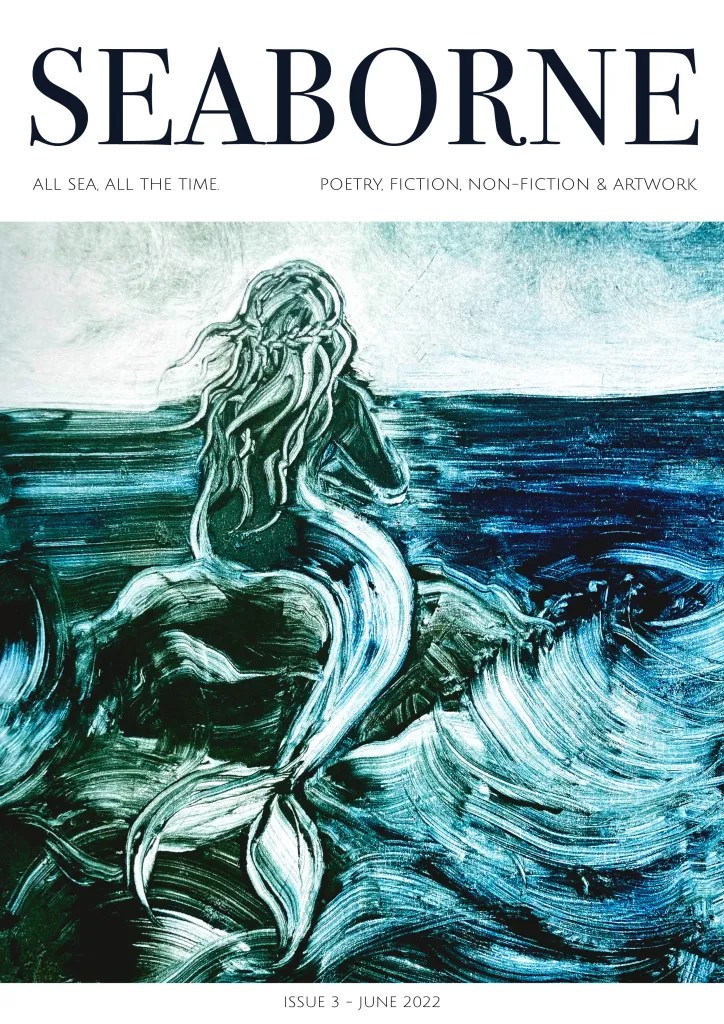
This month’s poem by Iris Anne Lewis is titled ‘I make myself a skirt of fish skin’. It was first published this summer in Seaborne Magazine. Iris said: ‘It’s difficult to know where the inspiration for a poem comes from. In this case, the phrase ‘I make myself a skirt of fish skin’ popped into my mind and the rest of the poem flowed from that. Since childhood, I have been fascinated by fairy tales and legends and so it was natural for the poem to evolve into a tale of a mermaid, a chimaeric figure found in folklore about the sea. Many cultures have traditionally held rites of passage from childhood into maturity. In the poem, a girl is encouraged by family and the wider community to embrace the transition from adolescence into womanhood.’
This month’s poem is by Linda Dyson, and it is called ‘Patinage’.
Linda said:’ The poem was inspired by watching many outstanding ice dance performances on TV. My love of skating goes back to Torvill and Dean’s landmark performance to the music of Ravel’s Bolero at the 1984 Winter Olympics. This took place while my father was dying – a fact that made it particularly uplifting for me. I was finally able to see them perform it live a few years ago.
‘These days, the extremely complicated and daring routines we see executed by modern skaters often defy belief and the performers seem to be transformed into superhuman beings when they step out onto the ice. This fact led to the images in the poem which I gave a French title because it seems more elegant and magical than the Anglo-Saxon term skating.
‘At the end of the day, of course, the skaters are human beings just like us, a fact made all too apparent when they step back onto ‘dry land’ and have to walk in an ungainly fashion to their seats. Can we be transformed for a moment when we consider these magical routines? Perhaps only in our dreams….’
I make myself a skirt of fish skin, a poem by Iris Anne Lewis has just been published in Seaborne Magazine, Issue 3. Editor Adriana Ciontea said of the poem, it’s ’so atmospheric and full of unique imagery, it’s a delight to get lost in it’.
Seaborne Magazine is a literary publication with an aim to celebrate the sea and support organisations that help to protect the sea and marine wildlife. Issue 3 is available in both digital and print formats. Beautifully illustrated by Caroline Scamell, the magazine is full of poetry, stories, and creative non-fiction inspired by the sea. For every copy sold, £1 will be donated to Sea Shepherd to support their marine conservation efforts.
To purchase the magazine or for further details please click the link here.
More good news with the announcement that Frank McMahon’s poem The War Against Speech has won the poetry section of the Gloucestershire Writers Network annual competition.
The theme this year was Voices and the judges were Kate Frost and Adam Horovitz.
You will be able to hear our winners and runners-up reading their work at The Times and The Sunday Times Cheltenham Literature Festival on Sunday 9th October from 7. 00 – 8.15 pm in the Regency Suite, Queens Hotel.
The other prize-winning pieces are:
Winning Prose Piece
In Captivity by Philip Douch
Prose Runners-up
Bind Us Together by Rebecca KlassenExposed by Marilyn TimmsPlease Leave a Message by Christine Griffin
Prose Highly Commended
Did you Cut Your Fringe Yourself? by Sallie AndersonSmoosh by Geoffrey MeadA Cacophony of Sound by Mrs Julie WiltshireWarrior by Cindy Moss
Winning Poem
The War against Speech by Frank McMahon
Poetry Runners-up
The Displaced Child by Kathryn AldermanSt Olaves by Jean Cooper MoranThe Conversation of Difficult Birds by Rose Lennard
Poetry Highly Commended
Limassol by Sophie LooseMiss Bailey Sits by Christine GriffinPhantom Tongue by Bethan ManleyRussian Dolls by Marilyn Timms
In an article first published by the literary development platformDialectpoet Frank McMahon writes about the journey from first inspirations and semi-legible scribbles to the big moment of publication.
I write this as my second volume of poetry, A Different Land, is being readied for publication in July 2022.
Somewhere in old workbooks and diary notes will be a record of the first line or lines of the first or oldest poem which is included in this new volume of poetry. And if I were to succumb to a state somewhere between OCD and “sad,” I guess I could trace the lineage of all the poems.
But now, as the final proofs are being prepared, it is too late to have second, fifth or eleventh thoughts about their soundness and quality. They will soon be out into the world, part of the rich flowering of poetry in this country and abroad. Nervous, excited, proud are appropriate adjectives to describe my fluctuating mental state but I am pretty sure that these are shared emotions among other poets and writers.
So I take some strength and comfort from the hours spent sharing and testing earlier drafts of poems with fellow members of my writing group and with skilled and experienced mentors. Yes, I also rely on the judicious opinions of my editor/ publisher and on those of other editors who have published some of the poems in their own journals, magazines, and anthologies.
Those times when we strive to capture lines which seem to come from nowhere, toil over drafts, decipher scribbled notes, erase text or move it elsewhere, worry about form, rhythm, word excess or repetition; these times are the essential hard yards of crafting something special, individual and universal until you have work to offer to an editor.
And in a curious way, I take comfort from rejections, not that they are ever easy to read but they have served as a spur to review, edit, revise or even file away forever.
And then you need good fortune, because editors have their very individual criteria and house style. However good your market research, you can only ever submit in hope.
I was very fortunate with my first collection. It was not my first submission to poetry journals which offered pamphlet or book publication but the content of some of my poems had strong environmental and social justice themes which matched the publisher’s ethos.
Palewell Press is a small but growing indie publisher (76 titles) based in London, I originally submitted ten poems and was then asked to send about twenty more. Fortunately, my editor considered that there were enough poems meriting publication in terms of quality and “fit.” Some poems were cast aside on grounds of quality too.
So when the editor opened the submissions window about 18 months ago, I felt I had enough relevant and good quality work to offer. I should add that I have sent work to other publishers and had it declined during this time – I have learned that hopes should never become assumptions.
Following the initial submission and its acceptance, I reviewed what I had sent, withdrew one and sent some more which were then included.
Now is a good time to say that as soon as I knew my book would be published, I began to think about marketing it. Small Indie publishers do not have the resources of Faber or Carcanet. As Paul Brookes of Wombwell has said, it is down to us primarily to market it.
So, I developed a marketing plan. The list below is not exhaustive but includes:
· having a launch event;
· reading at open mics (a great way to get yourself known.);
· trying to be a featured writer at poetry festivals (in person and on-line);
· publicity on local media, and using Twitter and Facebook;
· approaching local writers’ groups for a slot;
· asking fellow writers to review the book on Amazon or Waterstones;
· trying to persuade your local bookshop to feature and sell your book in-store;
· asking poetry magazines to review and post the review.
My publisher has a very good website but having your book featured on it can only be a small part of the marketing work.
PREPARING THE MS.
When my first book, At the Storm’s Edge, was being prepped, the editor suggested that the poems should be themed and she highlighted some lines from the poems which would work.
Not everything was a perfect fit but it worked pretty well. So we followed the same method this time, only I suggested the lines for her approval.
Editors and poets work in a shared space where negotiation is the crucial feature. You have to accept that they have the final say. There is a contract to be signed but what matters is having a mutually respectful relationship. And in both books, I had to look at proposed revisions, which mostly related to lay-out on the page. What might work in A4 may not work in A5.
I also needed to think about changes to improve clarity but there was never an attempt to have me change the meaning or intent of the poem.
So, drafts go back and forward until you settle on everything from front to back cover. These include the blurbs, a few sentences which the editor has sought from recognised poets.
I have been very fortunate to have two wonderful ones from JLM Morton and Adam Horovitz and when I read them, my spirits sang!
Next stage is when the editor sends the MS to the printer to prepare the e-version. And now, even though you have done it several times already, you go through each poem with a fine, forensic toothcomb for spelling, punctuation and layout.
Copy editing is an essential task, more hard yards but essential.
When that is signed off, you wait with bated breath to see your book and have the first copy in your hands.
‘A DIFFERENT LAND’ is the second collection of poems by Frank McMahon. It is published this month by Palewell Press.
Frank said: ‘My Editor thought this was an emotionally charged set of poems and I think that’s right. The inspiration has come from contrasting sources; the natural world, (particularly as experienced during and since lockdowns), social injustice, and our treatment of asylum-seekers.
‘Some of the poems are longer meditations on love, our Imperial history, and its continuing presence in our society.
‘Although some were responses to harrowing stories heard on social media, others capture happy and vivid memories. And one is a tribute to a poet of the 8th Century, Du Fu, considered by many Chinese to be their greatest poet. He wrote amazingly powerful verse whilst trying to find refuge for his family from the bloody civil wars of the time. Does anything sound familiar?
‘The title poem came out of the experience of walking the Wainwright Coast-to-Coast path and the stretch across the Pennine watershed.’
Sophie Livingston’s novel The Green March Hotel was one of 12 finalists in this year’s Mslexia First Novel competition. The judging panel included literary agents and novelist Hilary Mantel, author of the Wolf Hall series about the life of Thomas Cromwell. Sophie said, ‘Sadly, I didn’t win – but it is a fantastic confidence boost to have my book reach the final of this prestigious competition.’ The novel is about attempts by eccentric residents of a run-down hotel to rescue it from ruin and, in the process, make sense of their lives.
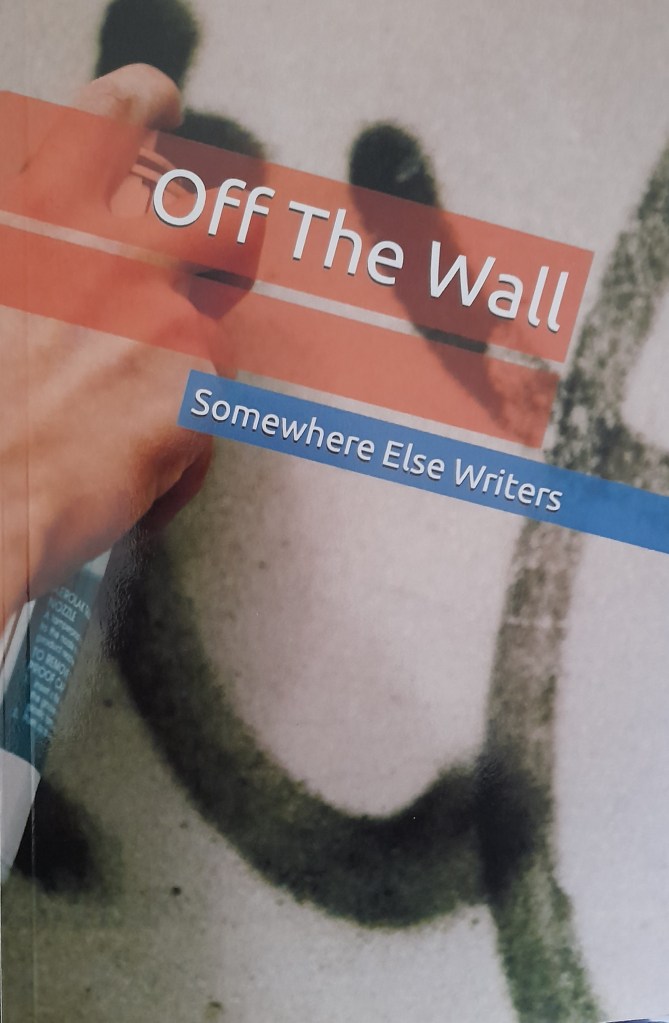
Ten years of the Somewhere Else Writers Group was celebrated this week with the launch of our anthology ‘Off The Wall’ at Fairford Library. The anthology is the culmination of months of work and includes QR codes linking to recordings of the authors reading their poems and short stories – along with explanations of the inspiration behind them. The 140 pages also include personal profiles of each of the writers explaining what motivates them to write. Profits will go to the RNIB ( Royal National Institute of Blind People).
The launch included live readings of work by six contributors. Iris Anne Lewis, who was the group’s first-ever chair, spoke about its origins, and Selwyn Morgan described the mechanics of creating the anthology. Among the guests was Rona Laycock, at whose creative writing classes the founder members met. The group was also very pleased to welcome members of the Fairford U3A creative writing group and to hear about their anthology plans. ‘Off the Wall’ will feature at the Fairford Literature Festival this Saturday.