
*
Cider Pressing Day by Andy Graham
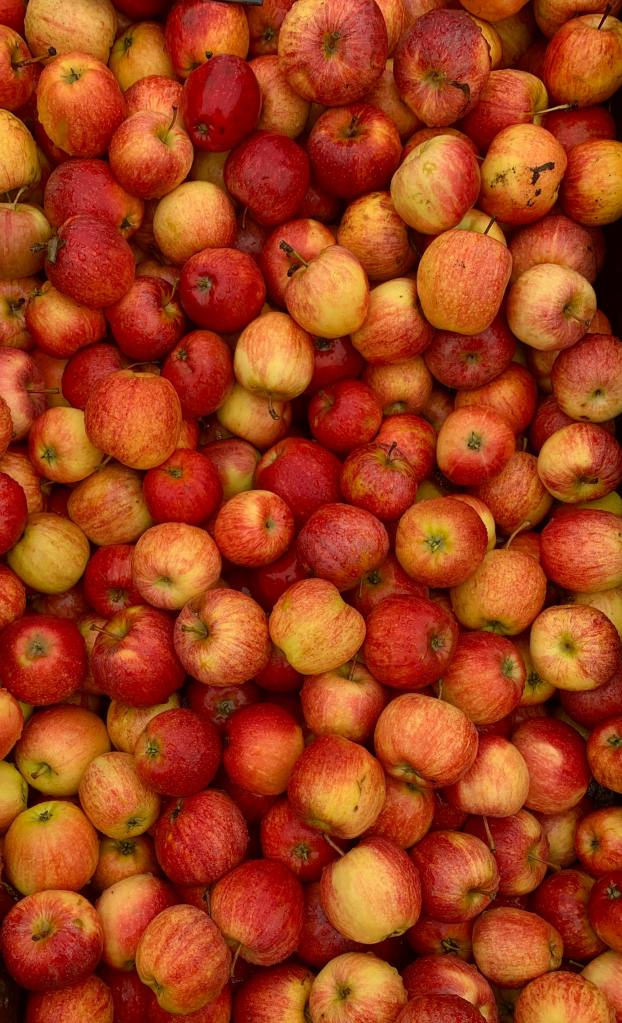
Apple juicing day is one of the fixed points in the allotment calendar. Three weeks earlier than last year, the apples are ripe and ready. The test: press your thumbnail against the skin — if it gives, we can begin.
With the rig set up on the collapsible table and buckets sorted: one to wash the apples; one for pulping the fruit with my eight-foot basher; one to collect the juice; and a final one for the discarded pomace.
With fermentation, cleanliness matters. Everything gets a proper clean.
Tony’s hose turns out to be a complete godsend for apple washing. You wouldn’t want to use the medieval well water, with its unsavoury community of bugs dating back, one suspects, to the Black Death.
Juicing kicks off at ten a.m. with the first apples picked, followed by bashing, pulping and pressing. A local wasp clocks the sugary action and heads back to the nest to tell his mates. Very soon, the rig is surrounded by a buzzing crowd of hundreds for the rest of the day. I begin to feel like the original wasp whisperer. They aren’t aggressive at all.
The day settles into a steady rhythm. Each press produces around a litre of juice, and from pick to press takes about twenty minutes. It’s clear this is going to take most of the day.
The day has purpose. The sun is shining. Chats and kindness punctuate the work.
First up, John appears. He looks well but has been struggling with a frozen shoulder, hindering his gardening but — suspiciously — not his bowling prowess on the club green this season. He has come to pick his runner beans, which have run amok.
We discuss a grand pyrotechnic event in late October or November to clear the old wood that has gathered over the years.
“Let’s have some sparklers and a hot dog,” I suggest. He is open to a bit of help to reset the plot and get it ready for spring.
He surveys his sweetcorn with a head-scratching eye. They have underperformed. He plants the same variety every year and they usually deliver a great crop — with the exception of the infamous year when the big-bellied badgers rolled across the patch and ate the lot in one sitting.
After receiving a bunch of sweet peas for his wife, he heads off happy, if slightly bemused by the vexing sweetcorn situation.
Terry calls out from afar, “What you doing? Making cider?” as he gets into his car. “I’ll have to report you to the constabulary. It’s against the rules,” he adds.
As eleven-thirty rolls around, there’s more picking, more pummelling, more squeezing, more buzzing.
Next door, Ken is busy with his industrially successful onion crop, hoeing enthusiastically in the sunshine, shirt sleeves rolled up. Yellow leather gardening gloves add a racy accent. He casts a critical eye over the cider operation and his engineering instincts kick in — horrified at the unsecured press.
“I’ll get you a couple of G-clamps.”
Engineering equilibrium restored, he fixes down the skidding red press.
The press has an attractive, almost steampunk look: a wooden handle attached to a spindle, a wooden basket, and a metal frame with a juice tray painted a jaunty red. It creates a satisfying thousand pounds of pressure, allowing those golden juices to flow. The addition of clamps speeds the process.
By now it is heading for four p.m. and a well-deserved break. Ken heads back to his house and returns with a couple of bottles of Old Hooky. This creates a squeezing pause.
We sit on old garden chairs on a verdant patch of fescue grass, discussing antique gardening tools.
When clearing out the old chicken shed — later the first glut hut — they found a steel shoe sole. Ken took it to an antique tool specialist, who identified it as a plate strapped to a boot to protect the sole from spade damage while digging. Restored with leather straps, it revealed an additional curiosity: the original owner was left-footed.
In the spirit of this impromptu show-and-tell, I share my favourite tool — a small barbed spike on a wooden handle, polished to a gloss by more than a hundred years of use.
It belonged to my maternal grandfather. He used it to harpoon weeds from the lawn before synthetic herbicides were invented. I demonstrate, extracting dandelions with the precision of a keyhole surgeon. A quiet handshake across the generations.
Then, mid-sentence, Ken exclaims, “Careful! There’s a jasper in your beer!”
What the hell is a jasper? From his urgency, it’s clearly the wasp upgrading from the apple juice bucket to my bottle.
Jasper — a word for wasp. A name that gives it a kind of swagger, possibly from a corruption of the Latin vespa.
Either way, there is indeed a jasper in the beer, and it turns out to be an occupational hazard of open-air drinking.
Beer finished. Back to work.
The smashing part of the process mesmerises. The trick is to hit the apples square, with precision and a satisfying, squidgy crunch. Any miscue and the apple pings out of the bucket.
The sun dips below the apple branch. As seven-thirty approaches — with ninety percent of the crop already pressed — one final push will take us beyond the twenty-five-litre goal.
Alison and Dougal the dog appear by the press to sit in a cider-maker’s sunset. Dougal, with his strange fascination for wasps, dances about the plot snapping and barking like a demented Winnie-the-Pooh. He may have been stung multiple times on paw and nose, but terrier tenacity fuels the mission.
A very satisfying day. The temperature in the shed fluctuates too much for fermentation, but the hall at home holds a steady eighteen degrees. The freshly pressed juice is loaded into the car.
The work is done. Time now for God’s yeasty little helpers to turn apples into cider.

